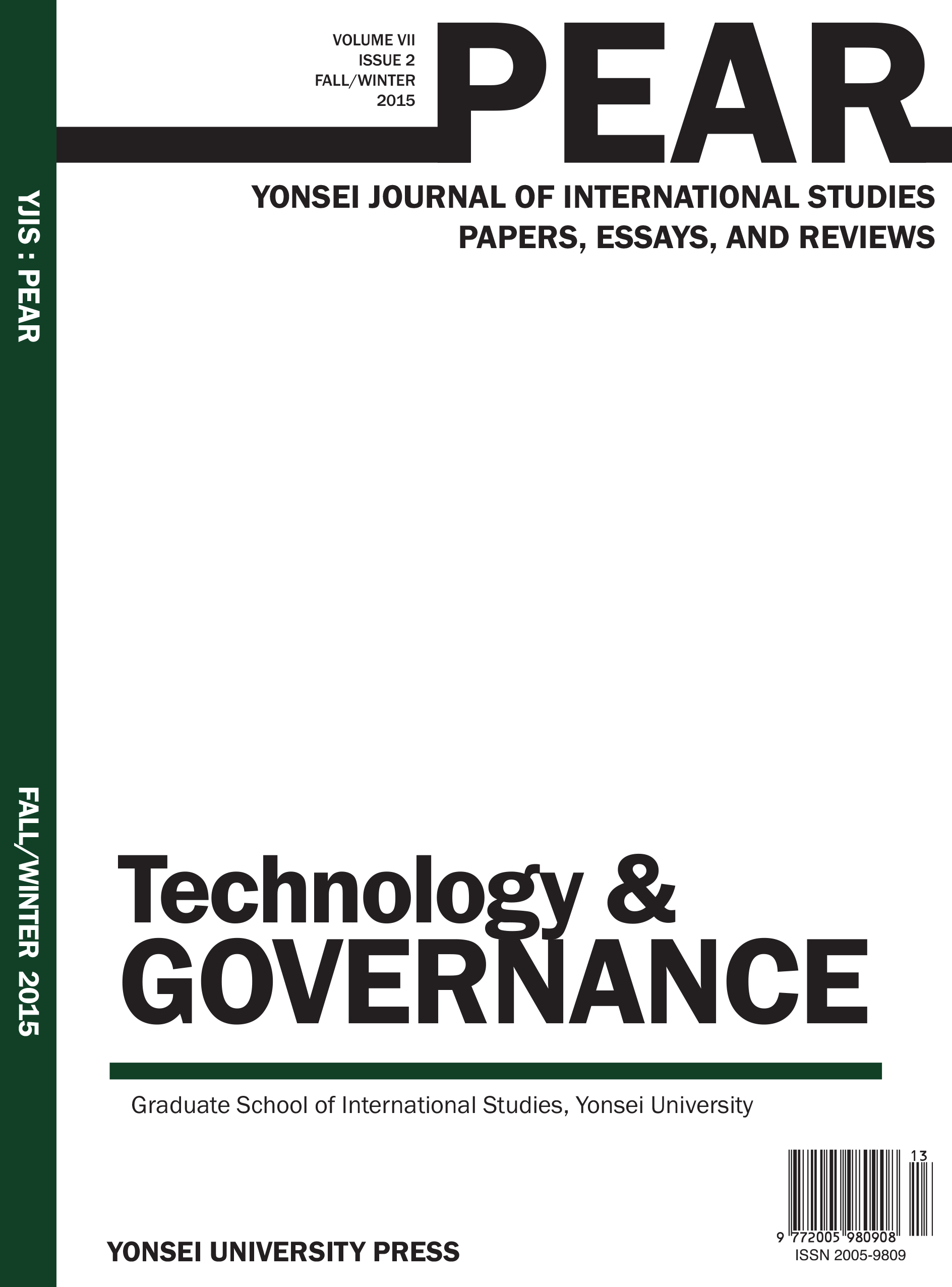
Title: A Defense of Utility Models: The Case of China
Issue: Technology and Governance – Volume 7 Issue 2, 2015
Publisher: Yonsei University Press
Click Here for Full Text PDF

Yonsei Journal of International Studies
A peer-reviewed academic journal of the Graduate School of International Studies, Yonsei University (ISSN: 2005-9809)
Title: A Defense of Utility Models: The Case of China
Issue: Technology and Governance – Volume 7 Issue 2, 2015
Publisher: Yonsei University Press
Click Here for Full Text PDF
Title: Abenomics: Revitalization and Resurgence of Japan
Issue: Technology and Governance – Volume 7 Issue 2, 2015
Publisher: Yonsei University Press
Click for Full Text PDF
Title: The Process of Decolonization, the Emergence of International Human Rights, and the Current De Facto Inequality of International Law
Issue: Technology and Governance – Volume 7 Issue 2, 2015
Publisher: Yonsei University Press
Click Here for Full Text PDF
Title: On China’s New Era Anti-Terrorism Governance in the Middle East
Issue: Technology and Governance – Volume 7 Issue 2, 2015
Publisher: Yonsei University Press
Click Here for Full Text PDF
Title: War-Monger or Judicious Realist? Liu Mingfu as a Historically-Minded America Watcher
Issue: Technology and Governance – Volume 7 Issue 2, 2015
Publisher: Yonsei University Press
Click here for Full Text PDF
Title: In the Public Eye: Monitoring Human Rights in North Korea
Issue: Technology and Governance – Volume 7 Issue 2, 2015
Publisher: Yonsei University Press
Click for Full Text PDF
Title: Review: A Tale of Two North Koreans
Author: Brandon K. Gauthier
Affiliation: Fordham University
Issue: Peace & Stability – Volume 7 Issue 1
Publisher: Yonsei University Press
Click for Full Text PDF
Title: A Paradoxical American Foreign Policy: Pivot to Asia
Author: Jung Taek Lim
Affiliation: Yonsei University
Issue: Peace & Stability – Volume 7 Issue 1
Publisher: Yonsei University Press
Click for Full Text PDF
ABSTRACT
Since Obama assumed office, his foreign policy aim was to reinvigorate Asia under the title of “Pivot to Asia”. Obama and his cabinet members unequivocally articulated that the strategy is designed not to agitate China, but to build more amicable ambiance for further economic-relations. However, U.S.-Japan security ties check China’s ambition in the Southeast China Sea and Washington-Beijing diplomatic discord is inevitable. The Obama’s Asia strategy illustrates a paradox that exists between economic and security realms. This paper analyzes Obama’s foreign policy in Asia and its implications for the region.
Title: Transitional Justice
Author: Myung Jung Kim
Affiliation: Johns Hopkins University
Issue: Peace & Stability – Volume 7 Issue 1
Publisher: Yonsei University Press
Click for Full Text PDF
ABSTRACT
This article aims to design a possible transitional justice in North Korea. Because it is difficult to imagine transitional justice for North Korea in the current state of the nation state, the essay is based on the hypothetical setting that transitional justice will be established after the current regime loses its power and after the reunification in the form of South Korea absorbing the North, similar to the case of Germany. The article explores the different types of trials and justice systems to design one that will be optimal for North Korea.
Title: Challenge to the Nation-State’s Sovereignty: The Influence of International and European Law in Today’s Globalized World
Author: Cristian Talesco
Affiliation: The Hong Kong Polytechnic University
Issue: Peace & Stability – Volume 7 Issue 1
Publisher: Yonsei University Press
Click for Full Text PDF
ABSTRACT
This essay aims to investigate the relationship between nation-state sovereignty and law in today’s globalized world. It will do so by bringing about two specific examples: the influence of international and human rights law on national legal order in Libya and Syria and secondly, the European Union (EU) and its new legal order which prevails over the national law of the member states. The first part will be addressed by bringing about examples from Libya and Syria. In Libya, international law has prevailed in breaking the right of Khadafi to use force against civilians. On the other hand, in Syria, international law has failed to protect civilians because of the deadlock at the UN Security Council. Moreover, international law did not prevent Syria from enacting emergency laws which resulted in the arbitrary arrest or detention of people.