Title: WRITING ABOUT THE TWO KOREAS: Interview with Daniel Tudor
Issue: Nations in Transition – Volume 9 Issue 2, 2017
Publisher: Yonsei University Press
Click Here for Full Text PDF

Yonsei Journal of International Studies
A peer-reviewed academic journal of the Graduate School of International Studies, Yonsei University (ISSN: 3140-2615)
Title: WRITING ABOUT THE TWO KOREAS: Interview with Daniel Tudor
Issue: Nations in Transition – Volume 9 Issue 2, 2017
Publisher: Yonsei University Press
Click Here for Full Text PDF
Title: North Korea in the European Press: An Analysis of Stereotypes in British, French, and German Newspapers
Issue: Interactions Across Borders – Volume 8 Issue 2, 2016
Publisher: Yonsei University Press
Click Here for Full Text PDF
Title: Only Words on Paper? Freedom of Speech & Expression in South Korea 
Author: Geoffrey Fattig
Affiliation: University of California
Issue: Law & Order – Volume 6 Issue 1
Publisher: Yonsei University Press
Download as PDF
Article 21 of the constitution of the Republic of Korea guarantees all citizens the rights to freedom of speech and expression. However, these rights have been under increasing threat in recent years due to a number of factors, including direct government interference in media operations, criminal defamation statutes, national security concerns, and regulation of internet content. During this time, the country has come under criticism in these areas from a range of international organizations and the United Nations Special Rapporteur for Human Rights. This paper will provide an overview of the media climate in South Korea along with the attempts made by various administrations to stifle dissenting viewpoints. It will utilize historical narrative to differentiate factors which are common to both sides of the political spectrum from those which are largely defined by political affiliation. This approach will allow for a broader understanding of the issues undermining freedom of expression in the country, placing them in proper historical and cultural context.The main findings of the paper are that both liberal and conservative governments have been guilty of heavy-handed measures to restrict public discussion, but that the recurrence of national security as a salient political issue has had particularly disturbing implications for both freedom of expression and Korean democracy. It concludes by examining some possible causes underpinning these issues, and offering a summary and analysis of the proposals made by the UN Special Rapporteur to improve the climate for free speech in the country.
To read more click Page 2 below
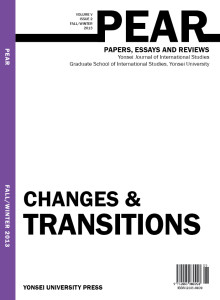
Title: The Donga Ilbo Advertising Coercion and Forced Layoff Case
Author: Seongbak Jin
Affiliation: Yonsei University
Issue: Changes and Transitions – Volume 5, Issue 2
Publisher: Yonsei University Press
Download as PDF
This paper looks at the Donga Ilbo Advertising Coercion and Forced Layoff Case in South Korea during the years 1974-1975, focusing on the confluence of three institutions: the press, the state, and commercial forces. A look into history finds that the state, dissatisfied with the Donga Ilbo’s reporting, leveraged market forces to force it into compliance with its view of proper reporting. This represented a watershed moment in the history of press-state relations in South Korea. The highly contentious state-press relationship, observed at the time of the layoff, can still be seen today. To explore the relationship between the press, the state, and commercial forces, this paper does the following: First, theories of media are introduced to provide a basis for analysis. Second, a brief history of the Korean press leading up the Donga Ilbo case is covered followed by a detailed overview of the layoff case itself. Lastly, the paper concludes by commenting on the implications of a contentious state-press relationship and current government-media relations in South Korea.
To read more click Page 2 below