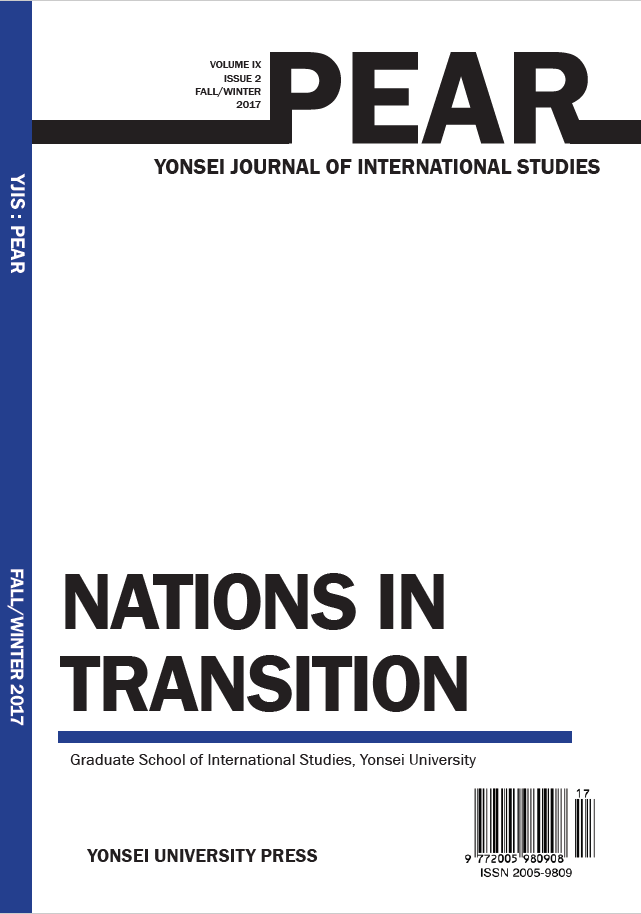
Title: WRITING ABOUT THE TWO KOREAS: Interview with Daniel Tudor
Issue: Nations in Transition – Volume 9 Issue 2, 2017
Publisher: Yonsei University Press
Click Here for Full Text PDF

Yonsei Journal of International Studies
A peer-reviewed academic journal of the Graduate School of International Studies, Yonsei University (ISSN: 3140-2615)
Title: WRITING ABOUT THE TWO KOREAS: Interview with Daniel Tudor
Issue: Nations in Transition – Volume 9 Issue 2, 2017
Publisher: Yonsei University Press
Click Here for Full Text PDF
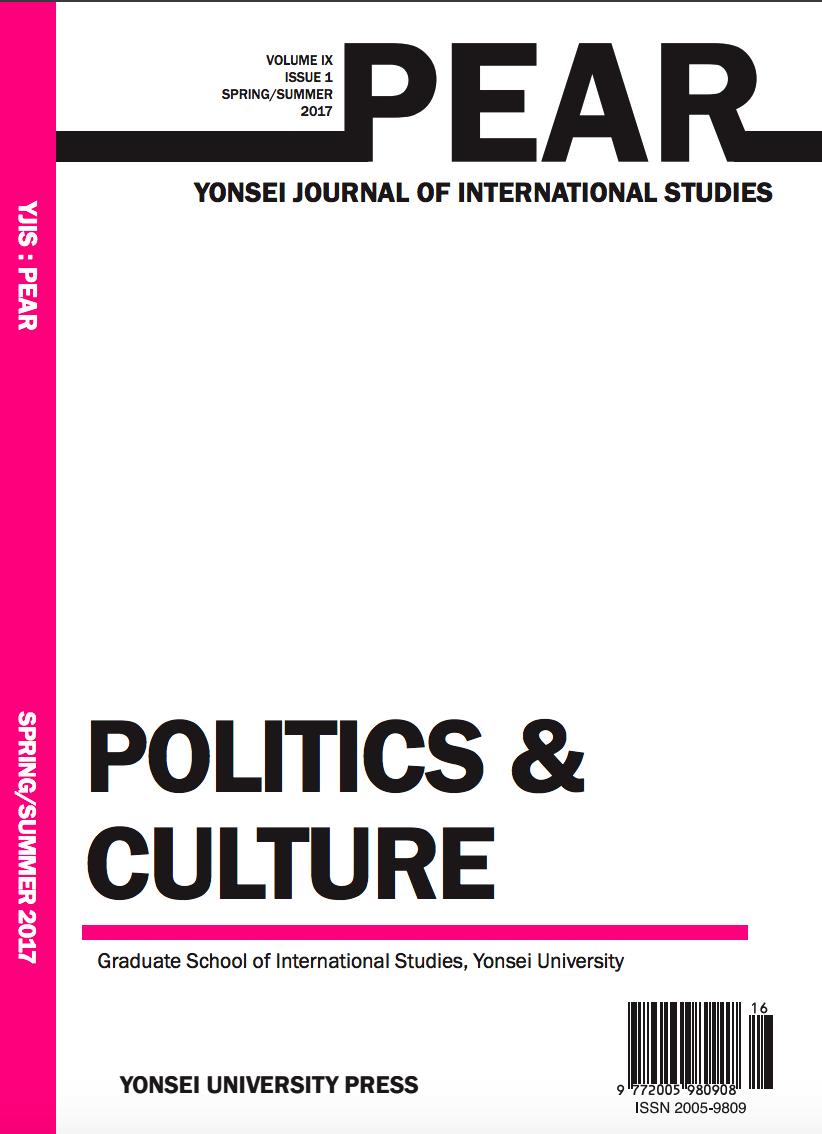
Title: Why North Korean Foreign Policy is Rational: An Application of Rationality Theories
Issue: Politics & Culture – Volume 9 Issue 1, 2017
Publisher: Yonsei University Press
Click Here for Full Text PDF
Title: North Korea in the European Press: An Analysis of Stereotypes in British, French, and German Newspapers
Issue: Interactions Across Borders – Volume 8 Issue 2, 2016
Publisher: Yonsei University Press
Click Here for Full Text PDF
Title: Post US-DPRK Nuclear Negotiation: Hidden Cycle of “Renege-Warning-Counter Renege”
Issue: Interactions Across Borders – Volume 8 Issue 2, 2016
Publisher: Yonsei University Press
Click Here for Full Text PDF
Title: In the Public Eye: Monitoring Human Rights in North Korea
Issue: Technology and Governance – Volume 7 Issue 2, 2015
Publisher: Yonsei University Press
Click for Full Text PDF
Title: Review: A Tale of Two North Koreans
Author: Brandon K. Gauthier
Affiliation: Fordham University
Issue: Peace & Stability – Volume 7 Issue 1
Publisher: Yonsei University Press
Click for Full Text PDF
Title: Transitional Justice
Author: Myung Jung Kim
Affiliation: Johns Hopkins University
Issue: Peace & Stability – Volume 7 Issue 1
Publisher: Yonsei University Press
Click for Full Text PDF
ABSTRACT
This article aims to design a possible transitional justice in North Korea. Because it is difficult to imagine transitional justice for North Korea in the current state of the nation state, the essay is based on the hypothetical setting that transitional justice will be established after the current regime loses its power and after the reunification in the form of South Korea absorbing the North, similar to the case of Germany. The article explores the different types of trials and justice systems to design one that will be optimal for North Korea.
Title: The Green Détente: Environmental Negotiations as a Trust-Building Mechanism for the Two Koreas
Author: Peter Chang Yup Kim
Affiliation: Johns Hopkins University
Issue: Peace & Stability – Volume 7 Issue 1
Publisher: Yonsei University Press
Click for Full Text PDF
ABSTRACT
Countries worldwide are increasingly attempting to address issues involving climate change and the environment, and the same phenomenon is occurring in the Korean Peninsula. The Republic of Korea is taking a growing leadership role in the global movement towards green growth. But what if this momentum was directed closer to home? This paper aims to assess the Green Détente as a policy mechanism for trust-building on the Korean Peninsula. It attempts to explore whether opportunities are available for environmental cooperation between the two Koreas as a stepping stone to future bilateral exchange.
Title: The Chinese Government’s Policy Toward North Korean Defectors
Author: Eunbee Chung
Affiliation: Yonsei University
Issue: Changes & Transitions – Volume 5 Issue 2
Publisher: Yonsei University Press
Download as PDF
The Chinese government’s repatriation policy for North Korean defectors has been a topic of controversy. Due to deteriorating living conditions in North Korea, many flee North Korea to find food or work. Many of them go to China, and yet they are greeted by hostility. While humanitarian activists and organizations urge the government to issue refugee status, Beijing identifies them as illegal economic migrants and forcibly returns them to North Korea where severe punishments await. The current essay assumes that Beijing’s repatriation of North Koreans is a breach to international refugee law, and explores political, economic, and social reasons contributing to the decision.
To read more click Page 2 below
Title: “Landscape as Political Project” – The “Greening” of North Korea, Sincerity or Otherwise? Investigating the Process of Ideological Incorporation in North Korea
Author: Robert Winstanley-Chesters
Affiliation: University of Leeds
Issue: Changes & Transitions – Volume 5 Issue 2
Publisher: Yonsei University Press
Download as PDF
Environmental management and practical policy strategies relating to it have always been an important part of North Korea’s approach to what would be locally described as “revolutionary” industrial/economic development. However, since the collapse of the wider Soviet Bloc, and the famine period of the mid 1990s, it has been possible to determine a change in policies relating to the management of the natural world in North Korea. Pyongyang’s government and institutions have begun to respond to developing themes within the theory and policy of governments, strategists and theoreticians from the wider world inspired by concepts of “conservation” and “preservation,” derived from environmental or “green” movements. North Korea has sought to incorporate such governmental or strategic themes within its ideology—in ways that do not destabilize its own philosophical or governmental frameworks, but instead serve to strengthen them. Accordingly, projects within North Korea, whose focus is environmental management, have begun to resemble those of the wider world and in the closer East Asian neighborhood, but to what end: environmental rehabilitation or regime survival? This paper builds on previous research identifying historical narratives relating to environmental management within North Korea and the routes through which its institutions translate ideological or philosophical development into practical policy; it investigates the routes through which North Korea incorporates foreign or external ideas within its own theoretical construct—how these ideas and projects spurred by them are utilised for domestic and international propaganda needs. It seeks to evaluate if the sincerity or otherwise of such an incorporation can be established and ultimately whether this would prove useful in the development of analysis focused on construction or translation of theoretical development or institutional functionality within North Korea.
To read more click Page 2 below